

Products of the body’s own metabolism not only have a regulatory effect on the immune system, but can also influence the growth or persistence of bacteria. The contribution of host metabolites in antimicrobial defence is still largely unexplored. We postulated that a targeted modulation of the host metabolism can inhibit pathogen growth and develop an antimicrobial efficacy against persisters. We investigated this paradigmatically with a Salmonella infection model. We used methods of bioinformatics and machine learning to identify new antimicrobially effective target structures anchored in the metabolism from highly complex metabolome and transcriptome data. In the Jantsch-Lab macrophages were infected with Salmonella and different signalling pathways of the macrophages will be disturbed. In the Dettmer-Lab, genome-wide gene expression analyses (in collaboration with the Genomics Core Unit of the University of Regensburg), comprehensive metabolome analyses as well as targeted quantitative metabolite and metabolic tracer analyses are performed on samples obtained from infected macrophages. The Spang group develops predictive models of pathogen control, network modelling of host-pathogen interaction and causal models for the identification of putative antimicrobial target structures. The new candidates are then validated in vitro and in vivo in the Jantsch-Lab and Dettmer-Lab. This provides the basis for new approaches to host-based therapy of multi-resistant pathogens.
Multi-resistant pathogens do not infect everyone they affect. Some people have high-end macrophages that control and fend off the infection, while other people’s macrophages cannot. We suspect the difference between these scavenger cells of the immune system in their metabolism. As a rule, nobody knows how fit his macrophages will be in the event of an infection. Therefore, it is important to better understand the characteristic properties of potent macrophages and then make these properties diagnosable. In this way, high-risk patients for infections could be identified early on. Furthermore, the metabolism of macrophages can be influenced in different ways not only by a variety of drugs, but also by an inflammatory reaction (metaflammation) caused by excessive food intake and triggered by metabolic processes. How these factors affect the fitness of macrophages to defend themselves against pathogens is one of the key questions in this scientific field.
In this project, we wanted to rely on a strategy that combines modern metabolic analysis and artificial intelligence methods with experimental infection immunology. All three areas have made great progress in recent years and we see the opportunity to make rapid progress in their networking. Therefore, research teams from all three areas were working together in our project. The Jantsch-Lab has set itself the goal of investigating the interplay between infection defence and immune metabolism and is responsible for the experimental work on infected macrophages. The Dettmer-Lab is well established in the field of metabolomics, i.e. metabolic analysis, and generates in our project high-dimensional measurement data on macrophage metabolism using modern mass spectrometers. In these data sets, the Spang group uses artificial intelligence methods to search for data patterns that can be used for diagnostics or the detection of therapeutic target structures. The group has been developing such algorithms for many years and applies them in clinical contexts.
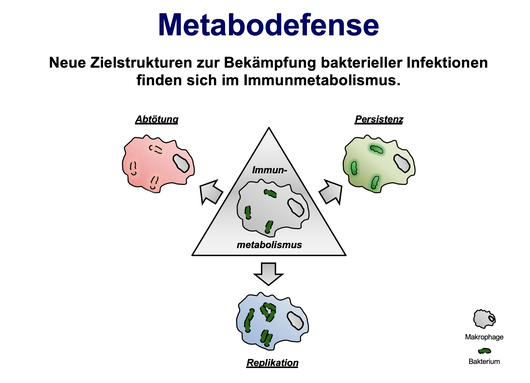
Within the Metabodefense project, the network partners succeeded in systematically decoding the host cell metabolism as a central control element of antimicrobial defense and in making it therapeutically accessible. Based on more than 40 targeted metabolic interventions in macrophages, the team comprehensively analyzed how manipulating individual metabolic pathways affects the control of intracellular pathogens. Two metabolic axes emerged as particularly decisive: choline metabolism, whose modulation strongly influenced the intracellular replication of Salmonella, and a neurotransmitter-associated metabolic pathway, where pharmacological inhibition significantly enhanced immune defense in vitro and in animal models. In parallel, the researchers identified the MI4 signature, a four-metabolite profile capable of reliably distinguishing infected from non-infected cells—across multiple gram-negative and gram-positive pathogens. Another key discovery was the pivotal role of the HIF-1α signaling pathway, which not only shapes the immune response but also regulates the synthesis of antimicrobial metabolites, establishing a conceptual link between hypoxia, cellular metabolism, and pathogen control. Together, these findings revealed novel therapeutic targets that could complement or even alleviate the pressure on classical antibiotic therapies.

Macrophages (red) phagocytose bacteria (green)
In addition to fundamental insights, the project generated a series of innovative scientific tools with long-term impact. These include the software solutions FastRet, designed for retention time prediction in LC-MS workflows, and ADMIRE, a system for anomaly detection in complex metabolomic datasets—both now available to the broader research community. Through the close integration of cell biology, mass spectrometry, systems biology, and machine learning, Metabodefense produced robust models and datasets that gained international recognition, including publications in Frontiers in Immunology, EMBO Molecular Medicine, Circulation, and the development of new R packages and web applications. The project established a new therapeutic paradigm by positioning host metabolism as an active ally in infection control, while simultaneously strengthening Bavaria’s role as an innovative research hub, supporting numerous early-career scientists, and laying the groundwork for future immunometabolic therapies that may one day complement—or even replace—traditional antibiotics.
The Jantsch-Lab is active in the field of infection immunology. One of the main focuses of research is the role of the immune metabolism in the infection defence mediated by cells of the innate immune system.
The Dettmer-Lab focuses on the field of comprehensive qualitative and quantitative metabolic analysis using coupled mass spectrometric methods (metabolomics).
The Spang group focuses on bioinformatics and machine learning. This includes the predictive modeling of high-dimensional molecular data, the development of new statistical/algorithmic methods for the analysis of highly complex data sets and the modeling of biological networks and processes of causal discovery.
Cooperations
Genomics Core Unit, Universität Regensburg
Prof. Dr. Michael Hensel, Universität Osnabrück
Prof. Dr. Dirk Bumann, Biozentrum Basel
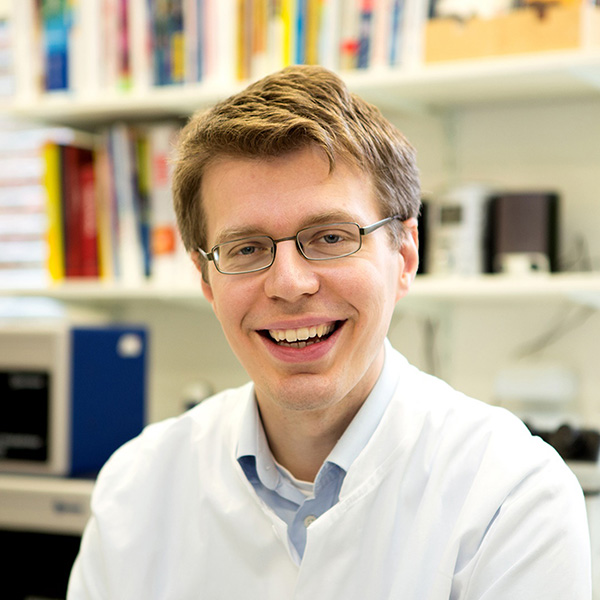
Prof. Dr. Jonathan Jantsch
Project Management
Universität Regensburg
Institut für Medizinische Mikrobiologie & Hygiene

PD Dr. Katja Dettmer-Wilde
Project Management
Universität Regensburg
Institut für Funktionelle Genomik

Prof. Dr. Rainer Spang
Project Management
Universität Regensburg
Institut für Funktionelle Genomik
Universität Regensburg
Institut für Medizinische Mikrobiologie & Hygiene
Universität Regensburg
Institut für Funktionelle Genomik